Website Redesign vs Refresh: What Does Your Business Actually Need?
By Richard Vasco · May 26, 2026
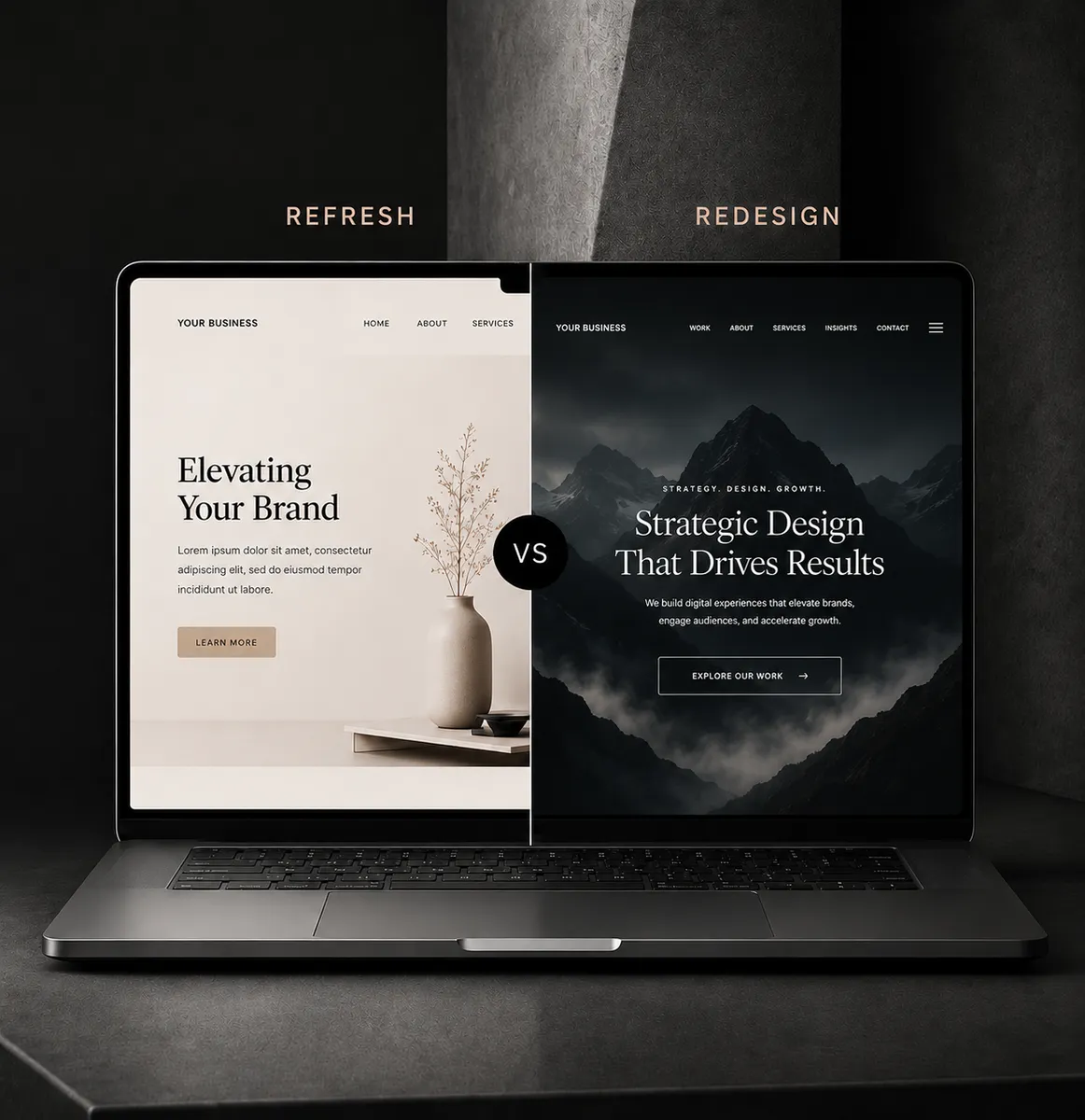
At some point, almost every growing business faces the exact same digital crossroads:
"Do we need a completely new website—or just an update?"
In 2026, making the wrong distinction can cost you tens of thousands of dollars in wasted budget or, worse, months of missed revenue and declining search rankings.
Deciding to update your online presence is no longer just a cosmetic choice. It is a strategic business pivot.
Some companies truly only need a visual upgrade to modernize their brand. Others are trying to slap a fresh coat of paint onto foundational, backend architectural issues like:
- 01Stagnant or dropping conversion rates
- 02Vague messaging that fails to qualify leads
- 03Frustrating, outdated user experiences (UX)
- 04Hard-coded SEO limitations and slow loading speeds
- 05Misalignment with your current brand positioning
A website refresh can quickly elevate your appearance. A complete website redesign can fundamentally transform your business performance.
Understanding which path your business actually needs will safeguard your timeline, your budget, and your growth trajectory.
What Is the Difference Between a Website Refresh and a Website Redesign?
While many stakeholders use these terms interchangeably, a professional creative agency views them as two entirely different tools built to solve entirely different corporate problems.
What Is a Website Refresh?
A website refresh minorly updates your front-facing user interface (UI) without altering the underlying site architecture, core code, or page URLs.
Think of it as cosmetic modernization. This process typically includes:
- 01Swapping out outdated photography and graphics
- 02Refining your color palette and typography systems
- 03Updating core copy, team pages, or product messaging
- 04Making minor UX tweaks to navigation or buttons
What Is a Website Redesign?
A website redesign is a comprehensive, strategy-first overhaul of your site's entire infrastructure, design system, and technical backend.
Think of it as structural engineering. This process typically includes:
- 01Developing an entirely new site architecture and user flow
- 02Deep user experience (UX) and conversion rate optimization (CRO) strategy
- 03Upgrading your Content Management System (CMS) for scalable performance
- 04Rewriting foundational brand positioning and messaging
- 05Executing a technical SEO restructuring and full website migration plan
At-A-Glance Comparison: Refresh vs. Redesign
- 01Primary Focus — Refresh: Aesthetics, branding polish, minor copy. Redesign: Strategy, revenue performance, scale.
- 02Site Architecture — Refresh: Stays exactly the same. Redesign: Completely restructured.
- 03SEO Impact — Refresh: Low risk / minor optimization. Redesign: High reward / requires strict migration.
- 04Average Timeline — Refresh: 2–4 weeks. Redesign: 2–3 months.
- 05Typical Cost (2026) — Refresh: $2,000–$10,000. Redesign: $10,000–$50,000+.
Signs Your Business Only Needs a Website Refresh
Not every business needs to scrap their entire site and start from scratch. If your digital foundation is stable, a refresh is a highly cost-effective way to stay competitive.
You may only need a visual refresh if:
- 01Your inbound lead pipelines and conversion rates are hitting targets.
- 02Your current site architecture and page layouts are clear and intuitive.
- 03Your overall brand identity is still aligned with your market positioning.
- 04Your desktop and mobile usability metrics look healthy.
- 05Your organic search (SEO) rankings remain strong and stable.
In these specific scenarios, elevating your visual polish is enough to strengthen your brand perception. According to Stanford University research, 75% of users judge a company's credibility based on its website design. Sometimes, bringing a clean, 2026 aesthetic to an already working engine is all it takes to maintain consumer trust.
Signs You Need a Full Website Redesign
A complete redesign becomes mandatory when your website suffers from foundational performance drops that no amount of beautiful photography can fix.
Common indicators that you need a structural rebuild include:
- 01High Bounce Rates & Low Conversions: Visitors land on your site but exit without taking action.
- 02Clunky Mobile Experience: The site fails to display natively or elegantly across modern mobile devices.
- 03Failing Core Web Vitals: Slow page speeds caused by legacy code or bloated plugins.
- 04Outgrown Infrastructure: Your team finds the backend CMS incredibly difficult to manage or scale.
- 05Organic Traffic Decline: Your search visibility is losing ground to more technically sound competitors.
According to Google's core performance guidelines, users demand instant, friction-free mobile experiences. If your site structure frustrates users, your search rankings and engagement metrics will steadily drop.
If your website architecture is broken, changing the font colors will not save your bottom line.
Why Most Businesses Wait Too Long to Redesign Their Website
Waiting until your website is completely broken to start a redesign is a costly operational mistake. Most companies delay the process until leads have completely dried up, competitors have totally dominated the search results, or technical debt has become incredibly expensive to reverse.
Websites rarely fail overnight. Instead, performance declines silently over time:
- 01User trust ticks downward as consumer expectations evolve.
- 02Micro-conversion friction slowly irritates modern buyers.
- 03Organic search visibility degrades as algorithm updates favor modern site structures.
By the time a business finally reacts to the decline, they are forced to rebuild under extreme pressure rather than strategically engineering a platform for long-term growth.
The Technical SEO Impact of a Website Redesign
Many brands fail to realize how intimately connected your website's structural code is to your organic search footprint. A strategic website redesign is a massive opportunity to dramatically lift your search presence by optimizing:
- 01Core Web Vitals and server-side page speeds
- 02Internal linking maps and contextual relevance
- 03Mobile responsiveness and layout indexing
- 04Clean content hierarchy (H1, H2, H3 structures)
However, a redesign also carries inherent SEO risk.
If your creative agency does not map out explicit URL structures, handle content updates carefully, and deploy flawless 301 redirects during the launch phase, you risk dropping your existing organic traffic. That's why advanced technical SEO must be integrated into the redesign process from day one—never treated as an afterthought.
Website Refresh vs. Redesign Cost
The financial investment required depends entirely on your operational goals and structural complexity. For a detailed breakdown of digital budgets this year, check out our guide on How Much Does a Website Cost in 2026?
- 01Typical Website Refresh Cost: $2,000–$10,000 — Visual refinement, updated asset styling, messaging alignment, and front-end polish.
- 02Typical Website Redesign Cost: $10,000–$50,000+ — Deep behavioral data analysis, comprehensive user experience engineering, custom interface design, clean development, and technical migration safety.
The ultimate difference is simple: A refresh optimizes your appearance. A redesign optimizes your corporate infrastructure.
FAQ — Website Refresh vs. Website Redesign
What is the main difference between a website refresh and a redesign?
A refresh upgrades superficial visual assets, colors, and fonts on top of your existing platform. A redesign rebuilds the entire site from the ground up, focusing on backend functionality, updated site architecture, enhanced UX strategy, and improved conversion funnels.
How often should an enterprise or B2B website be redesigned?
On average, high-performing businesses scale through a major website redesign every 3–5 years. This timeline ensures your digital ecosystem keeps pace with evolving web technologies, consumer behavior shifts, search engine algorithm updates, and your own internal business growth.
Will a website redesign hurt my current Google rankings?
If executed carelessly, yes—it can cause traffic drops. However, if handled by an agency that implements a strict technical SEO migration checklist (including mapping legacy URLs to new pages via proper 301 redirects), a redesign will ultimately improve your long-term search engine visibility.
Is a website refresh always cheaper than a redesign?
Yes, a website refresh requires significantly fewer hours of strategic mapping, engineering, and content production. It works brilliantly if you have an already profitable site that simply needs to look more modern.
Conclusion: Making the Strategic Choice
Not every conversion bottleneck requires you to throw out your current website and start from scratch. Conversely, cosmetic upgrades cannot save an architecture that is fundamentally misaligned with how modern consumers buy.
The key is identifying whether your current hurdle is visual or structural. In 2026, the brands winning the digital space aren't just making their websites look modern—they are ensuring their websites are engineered to perform.
If your current website no longer reflects the true quality, scale, or trajectory of your brand, let's audit it together. Discover whether a targeted visual refresh or a comprehensive custom website redesign is the smartest move for your business goals.
Contact Our Strategy Team →Continue Exploring
Service
WEBSITE DEVELOPMENT
We offer a complete suite of web development services tailored to your needs. From custom websites and powerful e-commerce platforms to high-performing landing pages and ongoing maintenance and hosting, we design, build, and manage websites that are as smart as they are stunning.
Case study
BookMe.com
Bookme, an all-in-one booking and marketing platform, partnered with us to lead a complete brand and digital refresh. Our work included a refined & refreshed visual identity, modernized brand assets, and a comprehensive new brand guide to ensure a consistent look and feel across every touchpoint. Alongside the refreshed branding, we designed a custom website and mobile experience with an intuitive, user-focused interface.
Next step
Start a Project
Tell us what you need. We typically respond within one business day.
Let's build it
Start a Project
If this article sparked a next step, tell us what you need. We typically respond within one business day.